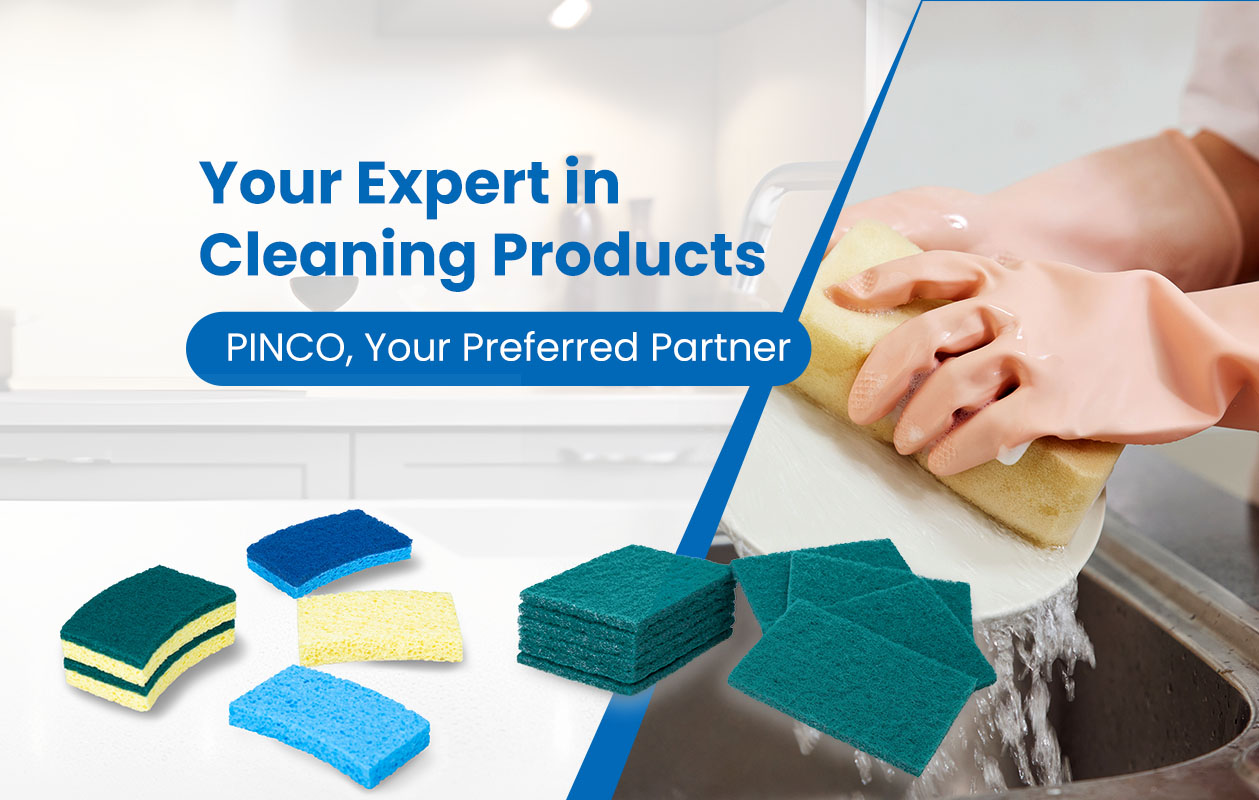
Choosing the right scourer is important for achieving effective cleaning results while protecting different surfaces. Soft scourers and hard scourers are designed for different cleaning tasks, and understanding their differences helps improve cleaning efficiency in kitchens, restaurants, food service environments, and industrial applications.
The main difference between soft and hard scourers comes from material structure, cleaning strength, durability, and application requirements. As a professional cleaning product manufacturer, PINCO focuses on producing reliable cleaning solutions with controlled materials, stable manufacturing processes, and flexible OEM and ODM services. Our Cleaning Scourer products are developed for different cleaning needs with consistent performance and quality.
Soft and hard scourers both help remove dirt and residue, but they are designed for different levels of cleaning intensity.
| Comparison Factor | Soft Scourers | Hard Scourers |
|---|---|---|
| Cleaning strength | Gentle cleaning | Strong abrasion |
| Main application | Light stains and daily cleaning | Heavy grease and stubborn residue |
| Surface protection | Higher protection for delicate surfaces | Suitable for durable surfaces |
| Durability | Moderate | Higher durability |
Soft scourers are often used for surfaces that require careful cleaning, while hard scourers are suitable for applications where stronger friction is needed.
According to the United States Food and Drug Administration, proper cleaning procedures are essential in food-related environments to maintain hygiene standards. Selecting suitable cleaning tools helps support effective sanitation practices.
Hard scourers are designed for demanding cleaning tasks where strong scrubbing performance is required.
Common applications include:
| Application | Cleaning Challenge | Hard Scourer Advantage |
|---|---|---|
| Commercial kitchens | Grease buildup | Strong residue removal |
| Grill cleaning | Burnt deposits | High abrasion performance |
| Heavy cookware | Dried food particles | Durable cleaning ability |
| Industrial equipment | Surface contamination | Long service life |
Hard scourers are especially useful in environments where cleaning frequency is high and surfaces require powerful cleaning action.
The difference between soft and hard scourers is closely related to the materials used during manufacturing.
Important material factors include:
Strength
Hard scourers require materials that provide enough friction to remove stubborn residue.
Flexibility
Suitable flexibility helps the product adapt to different cleaning conditions.
Durability
A quality scourer should maintain its structure during repeated cleaning cycles.
For professional applications, material consistency is especially important because unstable materials can lead to differences in cleaning performance between batches.
At PINCO, we carefully manage material selection to ensure stable product quality for different markets.
There is an important difference between working with a manufacturer and purchasing from a trader. Manufacturers directly control production processes, material selection, and quality standards.
PINCO manages the complete manufacturing process:
Raw Material Inspection
Materials are checked before production to confirm they meet product requirements.
Material Processing
Raw materials are processed according to controlled specifications to achieve the required cleaning performance.
Product Forming
Product structure, size, and density are controlled during manufacturing to maintain consistency.
Quality Inspection and Packaging
Finished products are inspected for appearance, structure, weight, and packaging condition before shipment.
These quality control checkpoints help maintain reliable performance across different orders.
Different industries may require different scourer types based on cleaning applications, packaging requirements, and market needs.
A professional OEM and ODM process includes:
Requirement analysis
Product specification confirmation
Sample evaluation
Production adjustment
Quality inspection
Customized packaging
PINCO provides customized cleaning product solutions while maintaining manufacturing efficiency. Our experience allows us to support different requirements without reducing product consistency.
For large-volume cleaning product projects, selecting the right scourer type is only one part of the decision process. Supply capability and quality management are equally important.
A practical sourcing checklist includes:
| Evaluation Area | Key Consideration |
|---|---|
| Product application | Does the scourer match the cleaning task? |
| Material standards | Are materials suitable for the target market? |
| Manufacturing capability | Can production support repeat orders? |
| Quality control | Are inspections completed throughout production? |
| Export experience | Can international requirements be supported? |
The International Trade Centre highlights that consistent quality and compliance capability are important factors in international trade. A structured manufacturing system helps maintain reliable product standards.
cleaning products supplied to international markets need to consider packaging standards, product information, and transportation conditions. Quality control should cover the complete production process.
PINCO focuses on production management, inspection procedures, and export preparation. From material selection to final packaging, every stage is controlled to support stable delivery.
The difference between soft and hard scourers mainly comes down to cleaning strength, material structure, and application requirements. Soft scourers are suitable for gentle cleaning, while hard scourers provide stronger performance for demanding tasks. With professional manufacturing capabilities, OEM support, and strict quality management, PINCO provides reliable cleaning scourer solutions for different commercial and industrial applications.