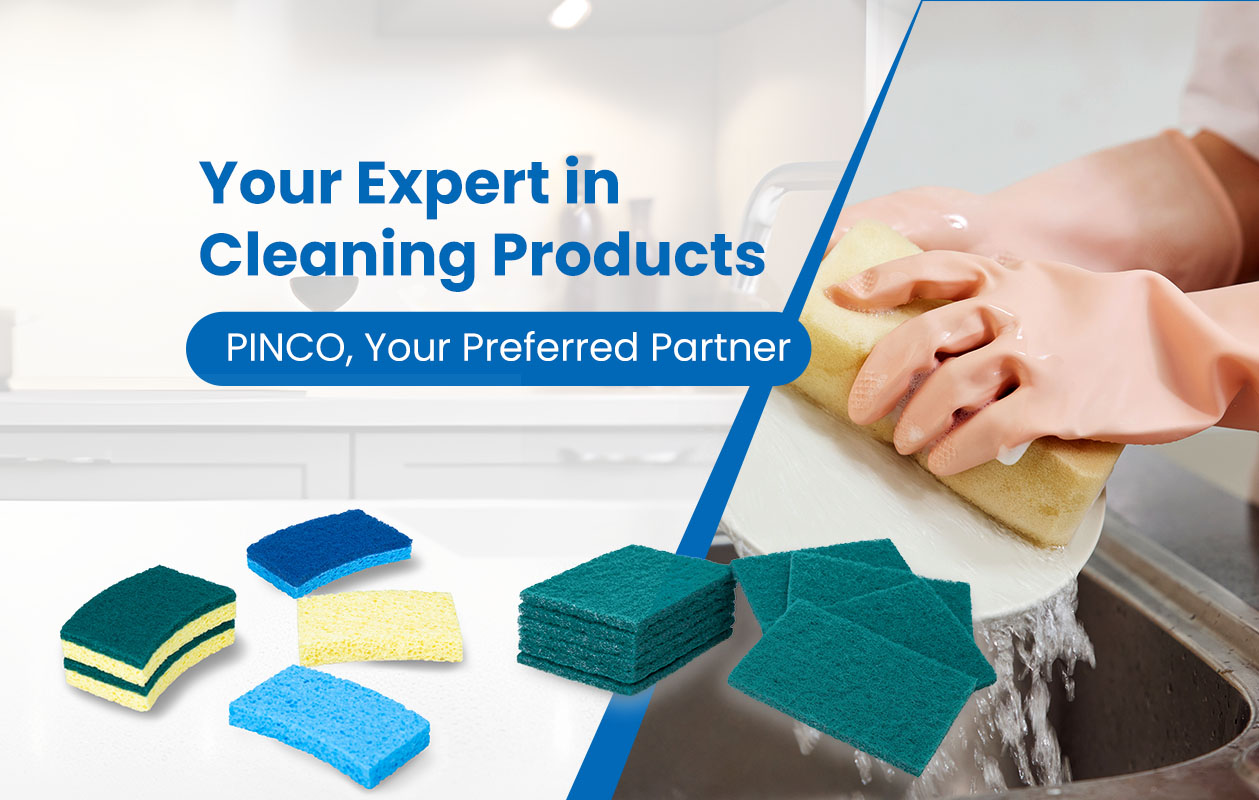
Nonwoven abrasive fibers are the working core of many industrial and household Scouring Pads. Their processing determines scrubbing strength, flexibility, thickness stability, and the final cleaning feel of the product. In professional scouring pad manufacturing, these fibers are not simply mixed and cut. They move through a controlled production flow that includes fiber selection, web formation, abrasive mineral application, bonding, curing, converting, and inspection. ISO explains that ISO 9001:2015 provides a framework that helps organizations deliver consistent products and services, which is why process control is essential when nonwoven abrasive fibers are turned into repeatable bulk production.
The first step is selecting the right synthetic fibers for the target cleaning grade. In scouring pad production, nonwoven abrasive structures are commonly built from synthetic fibers that can hold shape, accept abrasive minerals, and remain stable during repeated use. PINCO’s OEM and production content describes scouring pads as nonwoven structures made from synthetic fibers bonded with resin and abrasive particles, and it also highlights control over nylon fibers and abrasive scrub layers in factory production. This stage is critical because fiber quality affects tear resistance, density, odor stability, and the difference between non-scratch, medium-duty, and heavy-duty cleaning pads.
After raw fiber selection, the fibers are opened, distributed, and formed into a nonwoven web. This is the stage where the pad begins to take on its internal structure. PINCO’s manufacturing overview says Industrial Scouring Pads go through fiber web formation before abrasive mineral application, adhesive bonding, curing, cutting, and quality control. A stable web is important because uneven fiber layering can lead to weak spots, inconsistent thickness, or uneven abrasion across the finished pad. PINCO also notes that controlled fiber layering helps maintain pad shape during industrial use, which is a practical sign of process discipline rather than simple trading coordination.
Once the nonwoven structure is formed, abrasive minerals are applied to create the working scrubbing surface. This stage determines how aggressive or gentle the finished scouring pad will be. If abrasive loading is uneven, the pad may clean too aggressively in one area and too weakly in another. PINCO’s production materials describe abrasive mineral application as a core stage in industrial scouring pad manufacturing, and its OEM guidance stresses that material control decides whether the product becomes non-scratch, medium-duty, or heavy-duty. For buyers evaluating a cleaning pad factory, this is one of the most important quality control checkpoints in the whole manufacturing process overview.
After abrasive particles are applied, the nonwoven abrasive fibers need bonding and curing so the structure stays stable during use and shipment. PINCO’s published process description specifically includes adhesive bonding and curing as key production steps. Bonding quality matters because poor adhesion can lead to fiber shedding, weak scrubbing performance, or early pad breakdown. Curing also affects dimensional stability and helps the product hold a consistent structure through cutting, packing, shipping, and end use. This is one of the clearest differences between a real manufacturer and a trader. A manufacturer can control bonding chemistry, line conditions, and inspection standards directly, while a trader often has to depend on upstream factories for process consistency.
Once the bonded material is stabilized, the next steps are cutting, shaping, and packing according to the order requirement. In OEM and ODM projects, this stage is especially important because custom size, thickness, color, pack count, and private-label packaging all need to match the approved specification. PINCO’s OEM process article says its Jiangmen factory supports stable private-label programs with two main scouring pad production lines, in-house teams for design, quality control, shipping, and R and D, and output of 16,000 square meters of scouring pads per day. That kind of integrated structure is important for bulk supply considerations because converting accuracy and shipment coordination are part of supply reliability, not just finishing details.
| Production step | Main control point | Why it matters |
|---|---|---|
| Fiber selection | Synthetic fiber grade and consistency | Affects strength, flexibility, and durability |
| Web formation | Layering, density, thickness | Builds stable nonwoven structure |
| Abrasive application | Mineral distribution and loading | Controls scrubbing performance |
| Bonding and curing | Adhesion and structural stability | Prevents shedding and weak performance |
| Cutting and packing | Size accuracy and pack consistency | Supports OEM supply and repeat orders |
The table above reflects why procurement teams should review the full processing flow instead of judging only by a sample or quotation. ISO notes that implementing ISO 9001 means putting effective processes in place so products can be delivered consistently over time.
Nonwoven abrasive fiber processing needs inspection at every major stage. Buyers should ask how the factory checks raw fiber quality, web uniformity, abrasive distribution, bonding strength, cut accuracy, and packaging consistency. PINCO’s recent factory capability content emphasizes that its factory in Jiangmen covers 20,000 square meters, includes quality control, shipping, design, and R and D departments, operates two main scouring pad lines, and can produce 16,000 square meters per day. That matters because a factory with in-house departments and direct lines is better positioned to correct problems quickly than a supplier operating mainly as a trader.
Material selection for nonwoven abrasive fibers is not only a performance issue. It is also an export compliance issue. PINCO’s sourcing guidance says buyers should review fiber quality, bonding chemistry, abrasive type, thickness tolerance, and odor stability before approving volume orders. For EU-bound products, REACH obligations are relevant because the European Commission states that companies must reply within 45 days when consumers ask about the presence of a substance of very high concern in an article. That means a cleaning pad manufacturer needs organized records for fibers, resins, additives, and other material inputs, especially when building long-term OEM and bulk supply programs.
Before placing large orders, buyers should verify whether the supplier is a real manufacturer, how the nonwoven web is formed, how abrasive minerals are applied, where bonding and curing are controlled, what quality control checkpoints are used, and whether export documentation can be supported. PINCO’s public factory information shows the kind of production base that helps answer these questions clearly: a 20,000 square meter factory, 7 main workshops, imported scouring pad machinery from RANDO USA, two production lines, and daily output of 16,000 square meters. That combination gives stronger support for OEM scouring pads, bulk supply planning, and repeat production than a sourcing model built only on low pricing.
Nonwoven abrasive fibers are processed through a linked manufacturing system, not a single simple step. Fiber selection, web formation, abrasive application, bonding, curing, cutting, and inspection all work together to define the final scouring pad. For buyers comparing suppliers, the key point is not only whether a sample performs well today, but whether the factory has the manufacturing control to reproduce that same performance across future orders. That is where PINCO’s direct factory model, line capacity, and integrated quality structure provide a stronger basis for long-term supply.