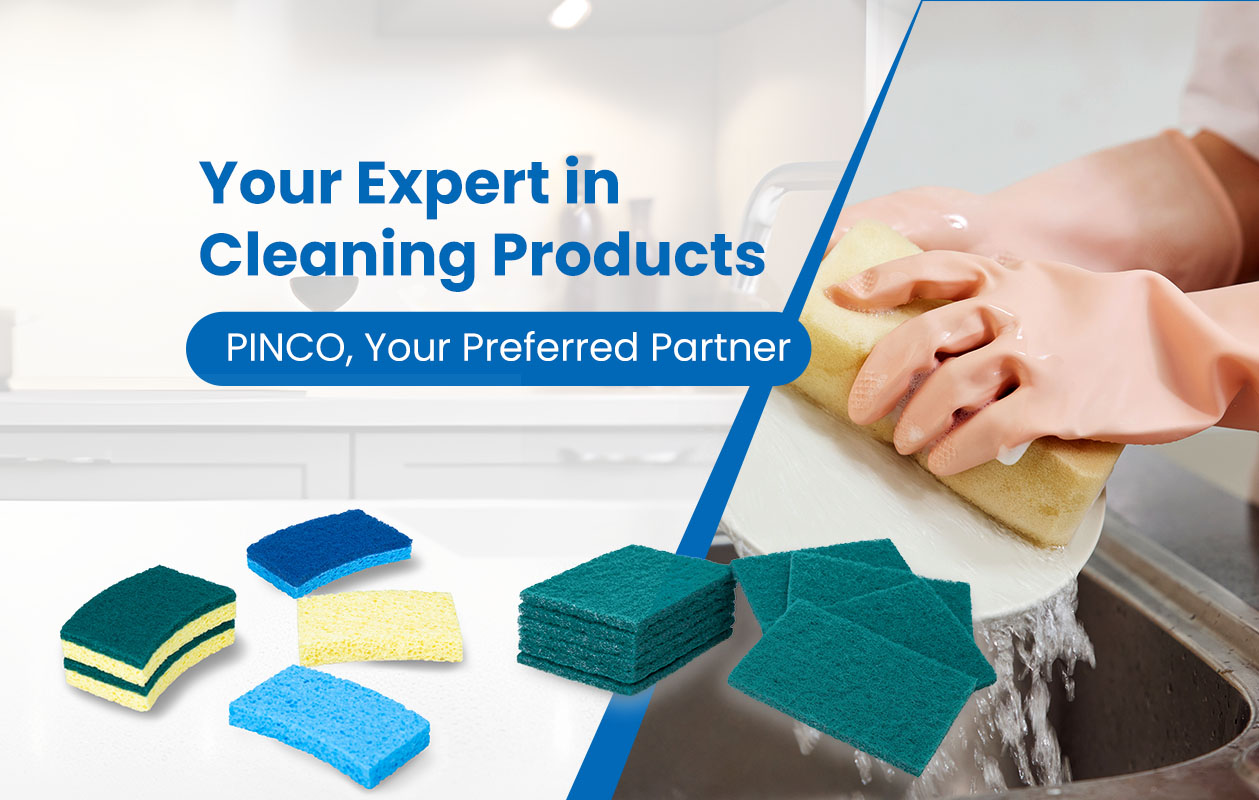
Procurement teams should not evaluate a Scouring Pad supplier by sample appearance alone. The more important issue is whether the supplier can maintain the same material quality, abrasion level, packaging accuracy, and delivery performance across repeat bulk orders. ISO states that ISO 9001 is a globally recognized standard for quality management and helps organizations improve performance, meet customer expectations, and maintain consistent processes. For scouring pad sourcing, that means the right questions should focus on factory control, not only on quotation.
This is the first question procurement teams should ask because it affects quality stability, lead time control, and problem solving speed. A trader may coordinate supply from multiple workshops, while a manufacturer can manage raw materials, process settings, inspection standards, and shipment records inside one system. PINCO’s public factory information states that its Jiangmen facility covers 20,000 square meters, includes 7 main workshops, operates 2 scouring pad production lines, and can produce 16,000 square meters of scouring pads per day. Its site also says the company has dedicated teams for quality control, design, shipping, sales, and R and D, which are the kind of internal resources procurement teams should verify during supplier review.
A reliable supplier should be able to explain the manufacturing process step by step, from raw material approval to web forming, abrasive distribution, bonding, cutting, inspection, and packing. This question matters because most bulk order problems come from unstable process control rather than one isolated finished goods defect. When a supplier can explain where thickness is controlled, how abrasive balance is checked, and how batch records are kept, procurement teams get a clearer picture of production discipline. PINCO’s recent OEM and factory capability content emphasizes integrated production, imported scouring pad machinery, and repeat supply support, which suggests stronger process visibility than a sourcing model based only on outside coordination.
Procurement teams should ask for the full quality control flow, not only the final inspection standard. Incoming material checks should cover fiber consistency, abrasive material stability, color, and base structure. In process inspection should focus on thickness, bonding strength, size tolerance, and surface uniformity. Final inspection should review appearance defects, contamination, labeling, carton quantity, and traceability. This line of questioning aligns with ISO 9001, which focuses on repeatable processes and continual improvement rather than informal visual review alone.
| Key question | Why it matters | What procurement teams should expect |
|---|---|---|
| Is this a manufacturer or a trader? | Confirms production control | Workshops, lines, output, internal departments |
| How is the process controlled? | Reduces batch variation | Clear flow from raw material to packing |
| What are the QC checkpoints? | Lowers defect risk | Incoming, in-process, final, pre-shipment checks |
| Can the supplier handle OEM and ODM? | Supports custom development | Sampling, approval, repeat production control |
| What compliance support is available? | Protects export shipments | Material records, traceability, document readiness |
For private label and project sourcing, procurement teams should ask how the supplier handles specification review, sample development, packaging approval, and mass production release. A weak OEM or ODM process often causes differences between approved samples and delivered goods. PINCO’s OEM process content says its factory setup and daily output support private-label programs and repeat bulk supply, which is important for buyers who need the same cleaning pad specification over multiple orders.
Procurement teams should also ask what material documentation the supplier can provide and how export market compliance is handled. For EU shipments, REACH is especially important. The European Commission states that companies must reply within 45 days when consumers ask about the presence of a substance of very high concern in an article. That means suppliers need organized chemical records, material declarations, and batch traceability. PINCO’s public information also mentions ISO 9001 and BSCI in connection with its factory profile, which supports its position as a manufacturer prepared for structured export supply rather than one-time trading orders.
The final question should focus on long-term supply performance. Procurement teams should ask about production capacity, lead time planning, packaging accuracy, and shipment support. PINCO states that it can manufacture 16,000 square meters of scouring pads per day, and its factory profile highlights in-house shipping and quality teams. These details matter because a supplier that supports large orders well is not only able to make the product, but also able to keep specifications stable while managing packaging and delivery over time.
The best procurement questions are the ones that test system strength. A dependable scouring pad supplier should be able to prove manufacturer identity, explain the manufacturing process, show quality control checkpoints, support OEM and ODM development, provide material compliance records, and manage repeat bulk supply with consistency. That is where a direct manufacturer like PINCO has a practical advantage, because factory scale, internal departments, and documented production capacity make supplier evaluation much clearer and more reliable.