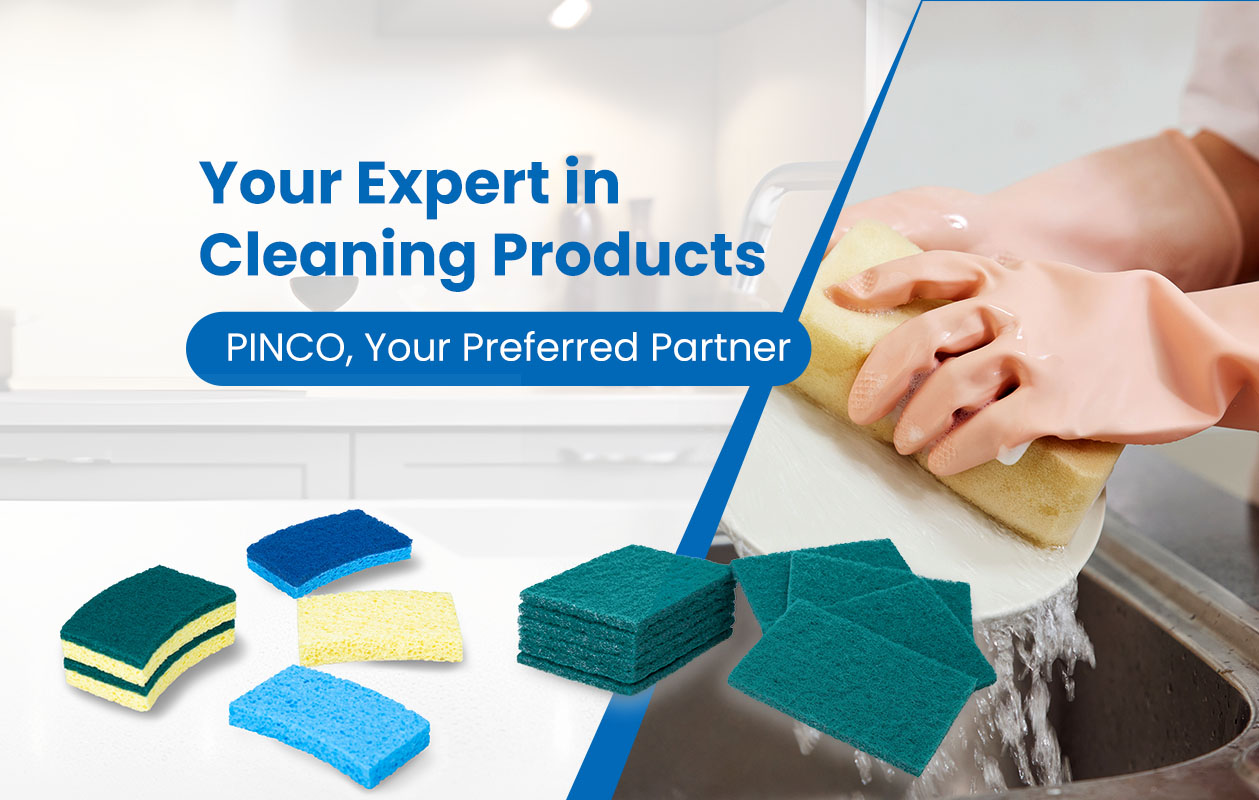
Choosing a Scouring Pad manufacturer is not only about comparing prices or reviewing a sample pack. Importers need to know whether the supplier can keep the same abrasion level, structure, packaging quality, and delivery standard across repeat bulk orders. ISO describes ISO 9001:2015 as the international standard for quality management systems and says it provides a framework that helps organizations deliver consistent products and services. For sourcing teams, that means the real question is not whether one sample looks good, but whether the factory system behind it is stable enough for long-term supply.
The first checkpoint is the supplier identity. A trader may offer flexible sourcing, but it usually depends on outside factories, which makes it harder to control raw material consistency, production scheduling, and corrective action. A real manufacturer can manage incoming materials, machine settings, inspection standards, and shipment records inside one system. PINCO’s public factory information states that it operates a 20,000 square meter facility with 7 workshops, 2 scouring pad production lines, and output of 16,000 square meters of scouring pads per day. Its profile also notes internal teams for quality control, design, shipping, and R and D. These are the kind of details importers should check first when evaluating whether a supplier can support stable repeat orders.
A dependable scouring pad manufacturer should be able to explain the full manufacturing process clearly. This usually includes raw material approval, fiber web forming, abrasive distribution, bonding, curing, cutting, inspection, and packaging. If the supplier cannot explain how thickness is controlled, how abrasive balance is checked, or how bonding strength is maintained, then batch variation becomes much more likely in mass production. PINCO’s recent factory content repeatedly emphasizes integrated production, line capacity, and process control, which is exactly what importers should look for when moving from trial order to regular bulk supply.
Quality control should be built into every stage, not left until the end. Importers should ask how incoming materials are inspected, what in-process checkpoints are used, how finished goods are sampled, and whether batch traceability is maintained after shipment. A factory with a strong quality system should be able to show clear control points for fiber quality, abrasive consistency, pad thickness, cutting accuracy, surface cleanliness, labeling, and carton count. ISO 9001 focuses on repeatable processes and continual improvement, which is why serious manufacturers use documented inspection routines rather than informal visual checks alone.
| What importers should check | Why it matters | What a capable manufacturer should show |
|---|---|---|
| Factory identity | Confirms direct control over production | Workshops, lines, output, internal departments |
| Manufacturing process | Reveals how consistency is maintained | Clear process flow from raw material to packing |
| Quality checkpoints | Reduces defect risk in bulk orders | Incoming, in-process, final, and pre-shipment inspection |
| OEM and ODM capability | Supports private label and custom projects | Sampling, approval, specification control |
| Export compliance | Helps reduce customs and market risk | Material records, certification support, traceability |
For private label or custom supply, the OEM and ODM process is one of the most important selection criteria. Importers should confirm how the supplier handles specification review, sample development, performance confirmation, packaging approval, and final production release. A weak OEM process often leads to differences between the approved sample and the shipped order. PINCO’s OEM related content highlights factory-based support for private label projects and repeat supply, backed by its in-house teams and production capacity. That matters because custom scouring pad programs require coordination between design, production, quality control, and logistics rather than simple order taking.
Importers should also verify whether the manufacturer can support export market compliance. For products entering the EU, REACH obligations are especially important. The European Commission states that when consumers ask about the presence of a substance of very high concern in an article, companies must reply within 45 days. This means factories need proper material declarations, traceable supplier records, and organized documentation systems. PINCO’s published factory information mentions ISO 9001 and BSCI, which supports its position as a manufacturer prepared for structured export programs rather than one-time spot orders.
A supplier may make a good sample, but that does not prove it can support bulk supply. Importers should review production capacity, lead time planning, packaging control, and shipping coordination before making a final choice. PINCO states that its factory can produce 16,000 square meters of scouring pads per day, and its company profile highlights shipping and quality control departments as part of the internal structure. For importers, this is important because bulk supply depends on more than output alone. It also depends on whether the factory can keep quality stable while maintaining packing accuracy and delivery schedules across repeated orders.
A practical project sourcing checklist should include five points. First, confirm the supplier is a real manufacturer with visible production assets. Second, review the full manufacturing process and the points where consistency is controlled. Third, verify quality control checkpoints and traceability standards. Fourth, check OEM and ODM workflow for sampling, specification approval, and repeatability. Fifth, confirm export compliance support, material records, and shipping coordination. When these areas are clear, importers can evaluate a scouring pad manufacturer by system strength rather than by price alone. PINCO’s disclosed factory scale, output, internal departments, and certification profile make it easier to pass that kind of review than a sourcing model built only on outside coordination.
Importers choosing a scouring pad manufacturer should look beyond the product photo and unit cost. The stronger supplier is usually the one that can prove manufacturing control, quality discipline, OEM and ODM coordination, compliant material management, and stable shipment support under one roof. That is where a direct manufacturer such as PINCO offers a more dependable sourcing foundation for long-term bulk supply.