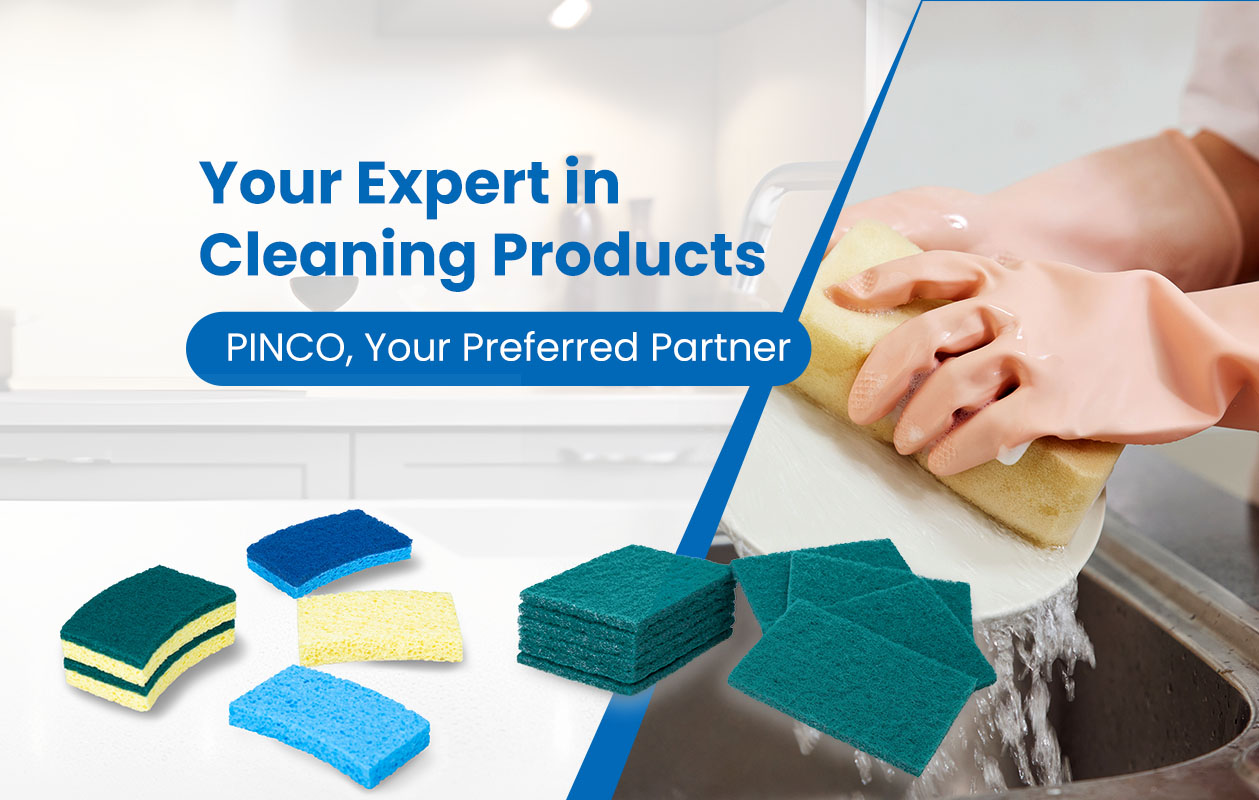
Industrial Scouring Pads are built for repeated cleaning, abrasion control, and stable performance across large production runs. The materials used in these pads determine how well they cut through grease, remove residue, resist deformation, and maintain consistency from batch to batch. For manufacturers, material choice is not only a product design decision. It is also a supply chain, quality control, and export compliance issue. According to ISO, ISO 9001 is a globally recognized quality management standard that helps organizations improve performance and deliver consistent products and services. In industrial scouring pad manufacturing, that principle begins with the right material system and controlled production standards.
The most common materials used in industrial scouring pads include nylon, polyester, polyurethane foam, and Cellulose based sponge layers. PINCO’s material overview notes that nylon is often used in the scouring layer because of its strength and heat resistance, polyester is valued for quick drying and chemical resistance, polyurethane foam offers flexibility and tear resistance, and cellulose provides strong absorbency with a softer touch. In practice, industrial scouring pads often combine more than one of these materials so the product can balance scrubbing power, liquid retention, durability, and user comfort.
Among all industrial scouring pad materials, nylon is one of the most widely used because it forms a stable abrasive web and performs well in demanding cleaning applications. A nylon based scouring layer can hold abrasive particles more evenly and maintain structure during repeated use. This is especially important for heavy duty scouring pads, commercial cleaning pads, and OEM cleaning pad production where surface consistency affects the final cleaning result. When the nylon quality is unstable, the pad may become too soft, too aggressive, or uneven across different lots. That is why direct manufacturers usually control nylon sourcing, fiber blending, and web forming more tightly than traders who depend on outside workshops.
Industrial scouring pads are not made only from abrasive fiber. The backing layer also matters. Polyurethane foam is commonly used because it is flexible, durable, and resistant to tearing. It gives the product shape, hand feel, and liquid holding capacity. Cellulose is another useful material when higher absorbency is needed. In some project sourcing cases, the buyer may need a softer kitchen cleaning pad, a stronger industrial scrub pad, or a dual layer scouring sponge for different end uses. Material structure should therefore be selected based on cleaning intensity, target market, and expected service life rather than price alone. PINCO’s material profile reflects this layered approach to industrial cleaning pad design.
When buyers compare a manufacturer with a trader, material control is one of the biggest differences. A trader may offer several types of scouring pads, but often cannot control whether nylon grade, foam density, or adhesive performance stays the same from one shipment to the next. A manufacturer can build material standards into every stage of production, from incoming inspection to line setting and finished goods approval. PINCO’s public factory profile states that it operates a 20,000 square meter facility with 7 workshops, 2 scouring pad production lines, and daily output of 16,000 square meters. It also highlights in house teams for design, quality control, shipping, and R and D. That kind of factory structure is much better suited for stable bulk supply and repeat OEM or ODM programs.
Material performance only becomes reliable when the production process is controlled. In industrial scouring pad manufacturing, the usual flow includes raw material approval, fiber web forming, abrasive distribution, bonding or lamination, curing, cutting, inspection, and packaging. Quality control checkpoints should verify nylon fiber quality, abrasive balance, foam density, bonding strength, pad thickness, cutting accuracy, and color consistency. If any of these checkpoints are weak, the final pad may show uneven abrasion, delamination, poor absorbency, or unstable durability. For bulk supply, these controls are essential because even small material shifts can multiply across thousands of units. PINCO positions its upgraded equipment and integrated production system as key strengths for maintaining this kind of consistency.
| Material | Main Use In Scouring Pads | Key Benefit |
|---|---|---|
| Nylon | Abrasive scrubbing layer | Strength, heat resistance, stable abrasion |
| Polyester | Fiber structure or supporting layer | Quick drying, chemical resistance |
| Polyurethane foam | Sponge backing | Flexibility, tear resistance, comfort |
| Cellulose | Absorbent sponge layer | High absorbency, softer cleaning feel |
In OEM and ODM cleaning pad projects, material choice should be confirmed early. A serious process usually starts with defining the target application, abrasion level, size, thickness, color, packaging method, and compliance requirement. Then the factory develops samples using selected material combinations and confirms performance before mass production. This is where project sourcing becomes more practical. Instead of buying only by appearance, the buyer can evaluate whether the pad uses the right nylon grade, the right foam structure, and the right bonding method for the intended market. PINCO’s OEM process content emphasizes stable private label development supported by in house teams and production capacity, which is especially useful when bulk orders need consistent material matching over time.
Material standards are also linked to export readiness. For EU bound products, REACH places obligations on substances of very high concern in articles, including communication duties when the threshold exceeds 0.1 percent by weight. The European Commission also notes that companies must reply to consumer inquiries about such substances within 45 days. For manufacturers of industrial scouring pads, this means material selection is not only about performance but also about documentation and compliance discipline. PINCO’s public information highlights ISO 9001 and BSCI in its factory profile, which supports its image as a manufacturer prepared for regulated export markets rather than short term spot trading.
When evaluating industrial scouring pad materials for bulk supply, buyers should check whether the supplier is a real manufacturer, whether the material system is stable, whether incoming and in process inspections are documented, whether OEM material matching is possible, and whether export compliance can be supported with clear records. Material quality affects cleaning performance, production repeatability, complaint rate, and long term supply stability. For this reason, the most dependable industrial scouring pads are usually built on controlled nylon, foam, polyester, and cellulose systems supported by factory level quality management. PINCO’s scale, line capacity, and internal coordination model show the advantages of working with a manufacturer that can control both materials and production instead of only arranging supply.