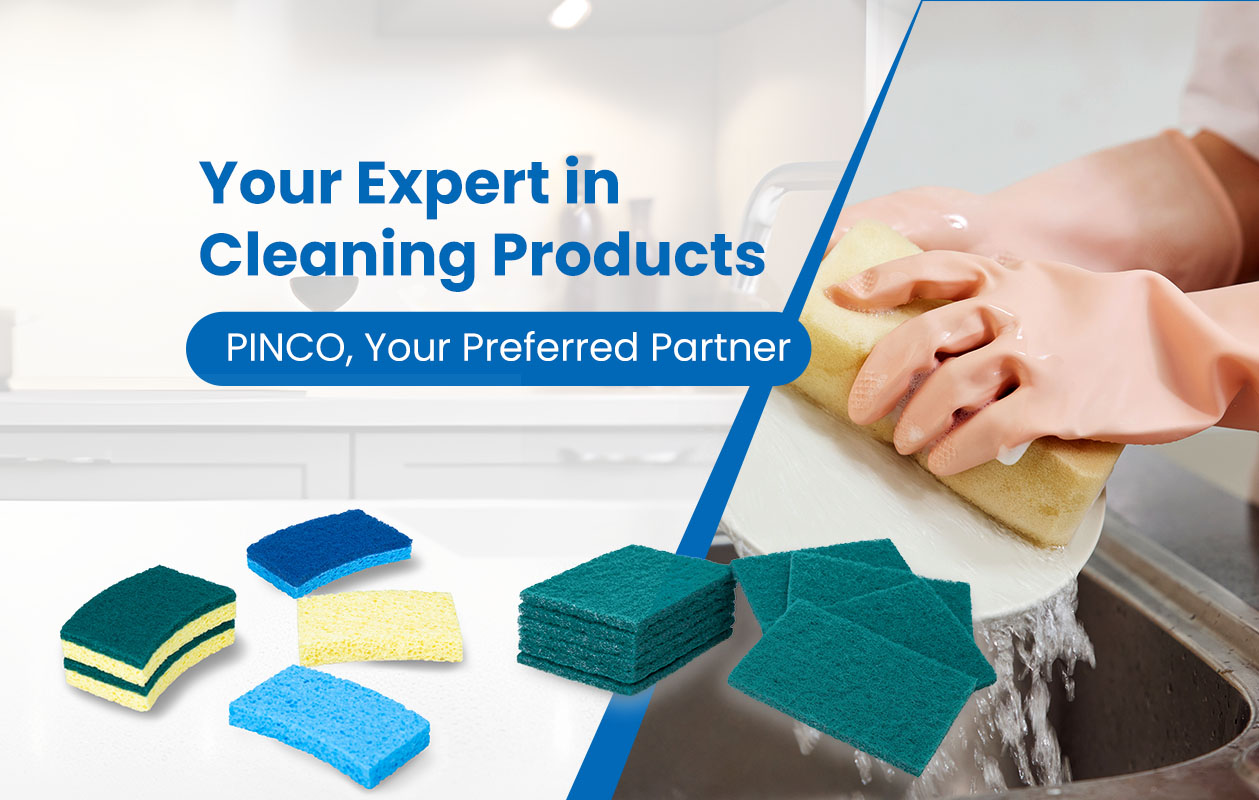
Professional Scouring Pads are judged by more than color or hand feel. In real supply programs, buyers care about whether every batch delivers the same cutting power, surface safety, pad thickness, shape stability, and packaging consistency. That is why a true scouring pad manufacturer uses a layered quality system instead of relying on visual checks alone. PINCO operates as a cleaning products manufacturer in Jiangmen with a 20,000 square meter factory, two main scouring pad production lines, in-house quality control, R&D, design, shipping support, and an inspection lab. Its official company information also states daily scouring pad output of 16,000 square meters and notes ISO 9001 and BSCI certification, which matters when repeat orders require stable process control rather than trading from multiple outside sources.
For professional scouring pads, the first checkpoint is raw material inspection. A factory must verify nonwoven fiber quality, abrasive mineral distribution, resin bonding condition, color consistency, moisture balance, and, when sponge-backed products are involved, foam density and recovery. This stage directly affects whether the abrasive cleaning pad will shed fibers, wear out too fast, or scratch sensitive surfaces. PINCO’s own quality content highlights incoming inspection of fiber strength, abrasive distribution, color consistency, and moisture condition as basic controls before production starts. In practical sourcing, this is also one of the clearest differences in manufacturer vs trader comparison. A manufacturer can trace the lot, verify the substrate, and block unstable material before it reaches the line. A trader often depends on supplier declarations and has less direct control over batch stability.
The most common physical tests for industrial scouring pad production focus on basis weight, thickness, and tensile behavior. ISO 9073 identifies mass per unit area, thickness, and tensile strength among the core test methods for nonwovens, which makes these metrics highly relevant for nylon scouring pad and nonwoven abrasive pad quality control. In production terms, basis weight affects cleaning aggressiveness and durability. Thickness affects feel, flexibility, and contact pressure. Tensile strength matters because a weak pad can tear during heavy scrubbing or machine use. A reliable professional scouring pads supplier checks these values against approved tolerances before bulk release.
Another critical test is abrasion performance. Buyers do not only need a pad that feels rough. They need one that maintains cleaning efficiency through repeated use. Abrasion and wear testing measures how fast the pad loses fiber, how well the abrasive layer stays attached, and whether the pad keeps a stable scouring profile after repeated cycles. ASTM abrasion methods are widely used in material durability evaluation, and their main value is consistency: repeated mechanical action under controlled conditions makes it easier to compare lots and production settings. For a scouring pad factory, this kind of test is useful for heavy duty scouring pad projects, floor maintenance pads, and any OEM program where pad life affects end-user cost.
Surface safety testing is equally important. A pad that cleans well but leaves visible damage will quickly fail in the market. That is why professional scouring pad quality control often includes scratch testing on stainless steel, coated cookware, ceramic, glass, and other customer-specified substrates. For non scratch scouring pads, the test target is not maximum abrasion. It is controlled cleaning power with low surface damage risk. This is especially important in OEM and ODM projects, where the same pad format may be sold into kitchen, janitorial, hospitality, or retail channels with different performance expectations. PINCO’s product range includes light duty, medium duty, heavy duty, extra heavy duty, and non scratch scouring pads, so sample validation by application is essential before mass production.
For sponge scourers and laminated products, bond strength and absorbency tests become another major checkpoint. The scrub layer must stay firmly attached to the sponge after repeated wet use, compression, and detergent exposure. Foam-backed versions also need checks for liquid uptake, resilience after squeezing, and structural recovery. PINCO’s own material guidance for sponge-based cleaning pads points to density, pore uniformity, thickness consistency, resilience, moisture retention, and structural recovery as key controls. These tests help prevent delamination, collapse, and early deformation in bulk supply.
These tests connect directly to the manufacturing process overview. In a controlled factory, production moves from raw material approval to fiber web forming, abrasive impregnation or coating, curing and bonding, slitting, die cutting, lamination when needed, in-line inspection, finished product sampling, and final packaging release. PINCO highlights serialized pre-production, in-production, and post-production support, which fits the needs of bulk supply programs that require development, approval, manufacturing, and shipment coordination in one system.
The OEM / ODM process also changes how tests are applied. In OEM programs, the main task is to match an existing approved specification, so tolerance control, repeatability, and carton labeling accuracy matter most. In ODM programs, the development stage is broader. The factory may help define abrasive level, size, thickness, color, packaging style, and use scenario, followed by sample matching and validation. PINCO’s own OEM and ODM content describes this process as starting from market positioning, cleaning strength, surface protection needs, packaging format, then moving into sample matching, color confirmation, abrasive adjustment, packaging design, and production scheduling. For buyers comparing manufacturer vs trader, this development capability is a major advantage because it shortens communication loops and reduces trial error.
Export market compliance should also be reviewed early, not after the order is packed. For many markets, chemical safety screening is part of the project sourcing checklist, especially for colorants, binders, foam components, and packaging inks. The European Commission states that REACH is intended to ensure a high level of protection of human health and the environment against harmful substances. On PINCO’s site, several product lines are described as compliant with REACH and RoHS requirements, showing that export-oriented material control is already part of its manufacturing mindset. For practical sourcing, that means restricted substance review, document collection, material traceability, and customer-specific compliance alignment should be built into the approval process before mass production starts.
In the end, the best quality control test program for professional scouring pads is never just one lab result. It is a connected system covering material standards used, in-line manufacturing control, finished product verification, packaging inspection, and export compliance review. PINCO’s factory profile, ISO 9001 based management approach, inspection lab, OEM and ODM support, and large-scale production capacity make that system more practical for long-term supply than a simple price-driven sourcing model. For buyers evaluating a professional scouring pads manufacturer, the safest path is to ask not only what tests are used, but also who controls them, where they are performed, and whether the factory can keep the same standard across every shipment.