
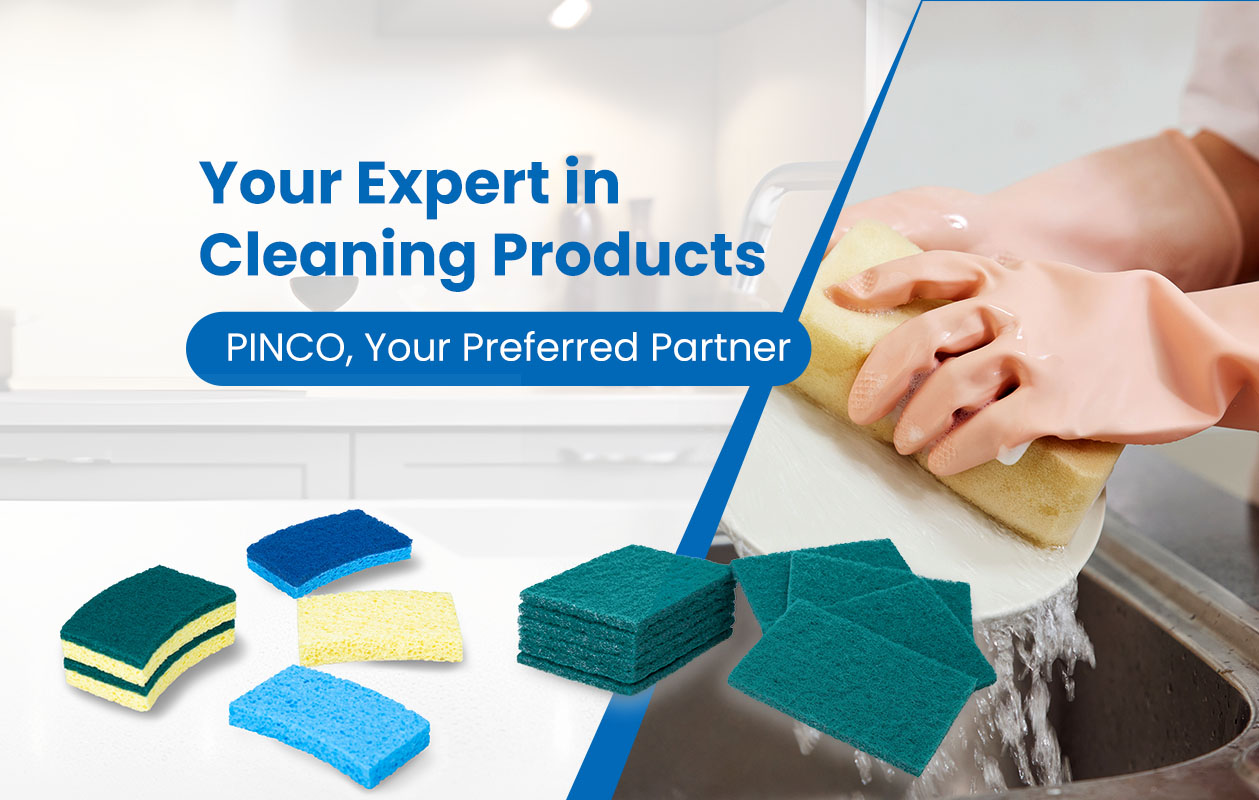
Abrasive Scouring Pads are widely used in kitchens, catering facilities, and industrial cleaning environments. Their cleaning efficiency and durability depend largely on the materials used in production. Foam layers, nylon fibers, and scrub fibers work together to create a pad that can remove grease and residue while maintaining flexibility and strength. Understanding material standards is therefore essential for buyers sourcing scouring pads in large quantities.
PINCO manufactures cleaning pads and related cleaning products using dedicated production lines supported by a quality control team and inspection laboratory. By carefully selecting and controlling materials such as foam substrates, nylon fibers, and abrasive scrub layers, the factory ensures stable product performance for wholesale supply and OEM or ODM projects.
Foam Layer Standards
The foam layer acts as the structural base of many scouring pads, especially Sponge scourers. High-quality foam should provide good elasticity, water absorption, and compression recovery. These properties allow the pad to retain detergent and maintain its shape during repeated cleaning tasks.
Material inspection typically focuses on foam density, pore uniformity, thickness consistency, and resilience after compression. If the foam structure is too loose, the pad may lose its shape quickly. If it is too dense, water absorption may decrease and reduce cleaning efficiency. Controlled foam quality helps maintain a balance between durability and absorbency.
Manufacturers also evaluate moisture retention and structural recovery to ensure that the foam layer remains stable after repeated squeezing and rinsing during use.
Nylon Fiber Standards
Nylon fibers form the main structural component of many scouring pad surfaces. These fibers provide strength, flexibility, and resistance to wear. Their durability allows the pad to withstand repeated friction during cleaning without breaking apart.
Quality inspection of nylon fibers usually includes tensile strength evaluation, fiber diameter consistency, and heat resistance verification. Uniform fiber distribution is important because uneven fiber networks can create areas that are either too soft or overly abrasive.
Stable nylon fiber quality ensures that the scouring pad maintains consistent cleaning strength across the entire surface, which is particularly important for bulk production orders.
Scrub Fiber And Abrasive Layer Standards
The scrub layer determines the pad’s actual cleaning capability. This layer typically combines synthetic fibers with abrasive particles designed to remove grease, burnt residue, or stubborn stains.
Material standards for scrub fibers focus on abrasive balance, bonding strength, and structural stability. Pads must provide enough friction to clean effectively while avoiding excessive scratching on common surfaces such as cookware or kitchen equipment.
Testing procedures often include abrasion resistance evaluation, tear strength testing, and structural stability checks after repeated friction cycles. Maintaining the correct abrasive level is critical for ensuring that the pad performs well across different cleaning applications.
Material Integration And Production Control
Although foam, nylon fibers, and scrub fibers are evaluated individually, their combined performance ultimately determines product quality. Manufacturing processes such as fiber formation, bonding, curing, and cutting must be carefully controlled to maintain consistent material integration.
PINCO manages these processes through controlled production parameters and laboratory testing equipment. Abrasion testers, pressure testing tools, and microscopic inspection help verify that materials are properly bonded and evenly distributed throughout the cleaning pad structure.
These quality control procedures help ensure that scouring pads maintain stable durability and cleaning performance across large production volumes.
Conclusion
The performance of abrasive scouring pads relies heavily on the quality of foam substrates, nylon fibers, and scrub fiber layers. By applying strict material standards and controlled manufacturing processes, manufacturers can produce cleaning pads that combine durability, absorbency, and effective abrasive performance.
For international buyers sourcing cleaning products in bulk, working with a manufacturer that maintains structured material inspection, laboratory testing, and stable production systems helps ensure consistent product quality and reliable long-term supply.