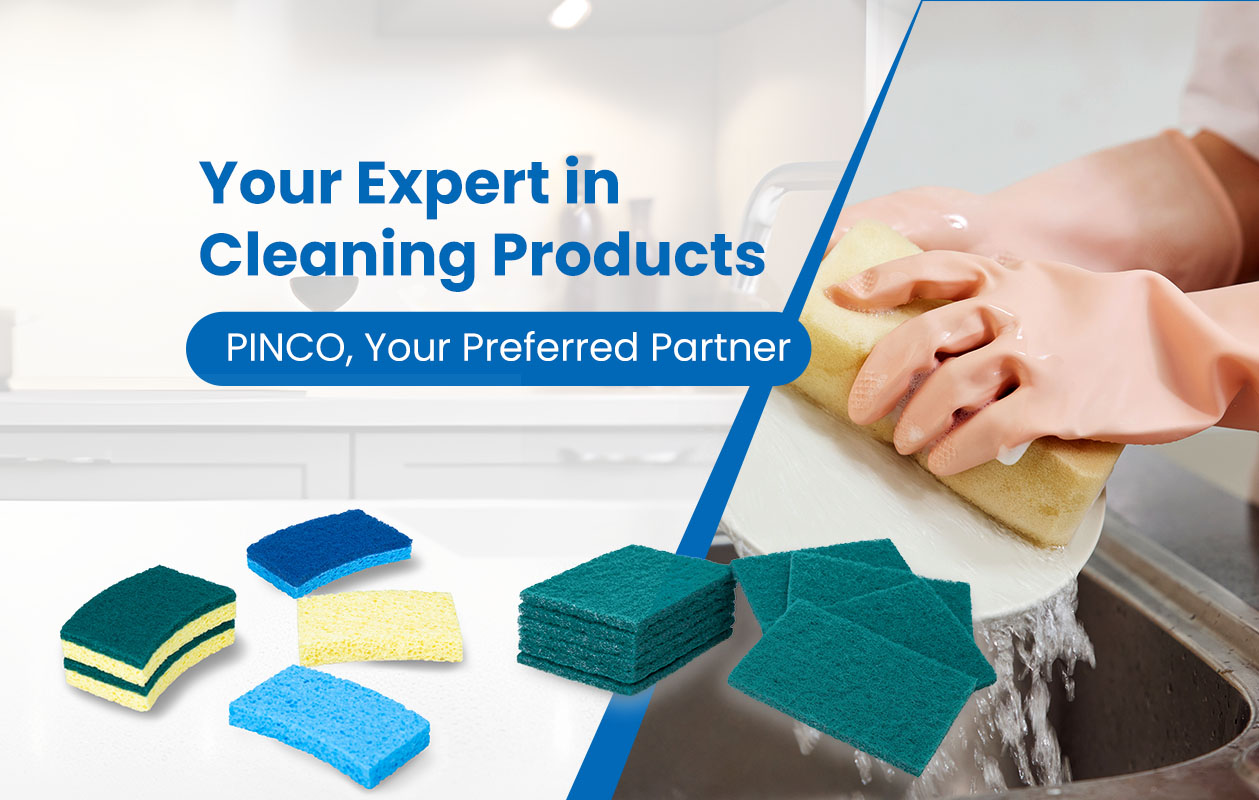
In large-scale Sponge and Scouring Pad manufacturing, the choice between wet processing and dry processing significantly affects product density, durability, bonding strength, and cost structure. For commercial and private-label buyers, understanding these two manufacturing approaches helps evaluate supplier capability and long-term supply stability.
Professional manufacturers with dedicated production lines—such as PINCO—structure their processes to balance efficiency, material control, and quality consistency in bulk supply programs.
Wet processing typically involves resin or polymer systems that are mixed in liquid form, foamed or structured, and then cured through controlled moisture and temperature conditions.
Liquid-based polymer or resin preparation
Controlled foaming reaction
Moisture-managed curing process
Flexible density control
Greater flexibility in density customization
Strong internal bonding within sponge matrix
Uniform cell structure formation
Good absorption properties
Longer curing times
Higher energy requirements
Moisture control sensitivity
More complex environmental management
Wet processing is often used when precise structural softness, absorption rate, and compression recovery are critical.
Dry processing relies more on mechanical layering and bonding of pre-formed fiber webs or foam sheets.
Pre-manufactured fiber or foam sheets
Mechanical compression and bonding
Adhesive-based lamination
Heat or pressure stabilization
Faster production cycles
Lower energy consumption
Reduced water management requirements
Easier scalability for high-volume output
Slightly less flexibility in internal cell customization
Greater reliance on adhesive systems
Requires precise pressure control for uniform density
Dry processing is commonly applied in abrasive scouring pads and laminated sponge-abrasive combinations where structural strength and cost efficiency are priorities.
Wet processing allows fine-tuned density adjustment during foaming.
Dry processing depends on pre-formed material consistency and compression calibration.
Wet-processed sponge cores may offer enhanced internal cohesion.
Dry-processed laminated systems provide strong surface bonding when controlled properly.
Wet processing integrates abrasive within structure when required.
Dry processing applies abrasive layers separately and bonds them afterward.
For bulk commercial supply, scalability is essential.
Dry processing typically supports faster line speeds and reduced changeover time.
Wet processing may require longer stabilization phases before cutting and packaging.
Manufacturers with automated production lines and dedicated scouring pad systems—like PINCO—optimize dry and laminated processes for high-volume efficiency while maintaining consistent abrasion grade performance.
Both processes require structured QC checkpoints:
Thickness and density measurement
Compression recovery testing
Abrasive strength verification
Bonding durability inspection
Tear resistance testing
In dry lamination systems, bonding inspection becomes especially critical to prevent layer separation.
ISO-aligned quality management systems improve process repeatability regardless of method.
Wet processing may offer:
More flexibility in sponge softness customization
Adjusted absorption characteristics
Dry processing may offer:
Faster customization turnaround
Easier dimension adjustments
More efficient bulk packaging compatibility
Structured OEM workflows allow manufacturers to align processing method with performance targets and cost expectations.
Wet processing often involves:
Higher equipment complexity
Greater energy use
Increased moisture control requirements
Dry processing generally results in:
Lower operational cost per unit
Faster production cycle
Reduced environmental control cost
For high-volume commercial contracts, dry or laminated systems often support more competitive bulk pricing.
Processing method affects:
Moisture stability during sea freight
Compression behavior during storage
Structural recovery after transport
Proper curing and stabilization are critical for export-ready supply, especially in humid shipping conditions.
Manufacturers experienced in export logistics integrate packaging design to protect structural integrity regardless of processing method.
Wet and dry processing methods each offer distinct advantages in cleaning sponge manufacture.
Wet processing emphasizes:
Density customization
Internal cohesion
Absorption control
Dry processing emphasizes:
Production speed
Scalability
Cost efficiency
Strong lamination for abrasive applications
For large-scale commercial and OEM cleaning pad programs, manufacturers must balance structural performance, automation capability, quality control discipline, and export readiness.
Professional manufacturers with integrated production systems—such as PINCO—select and optimize processing methods based on durability requirements, bulk supply efficiency, and long-term cost control.
In high-volume cleaning supply agreements, manufacturing process selection directly influences product consistency and supply reliability.