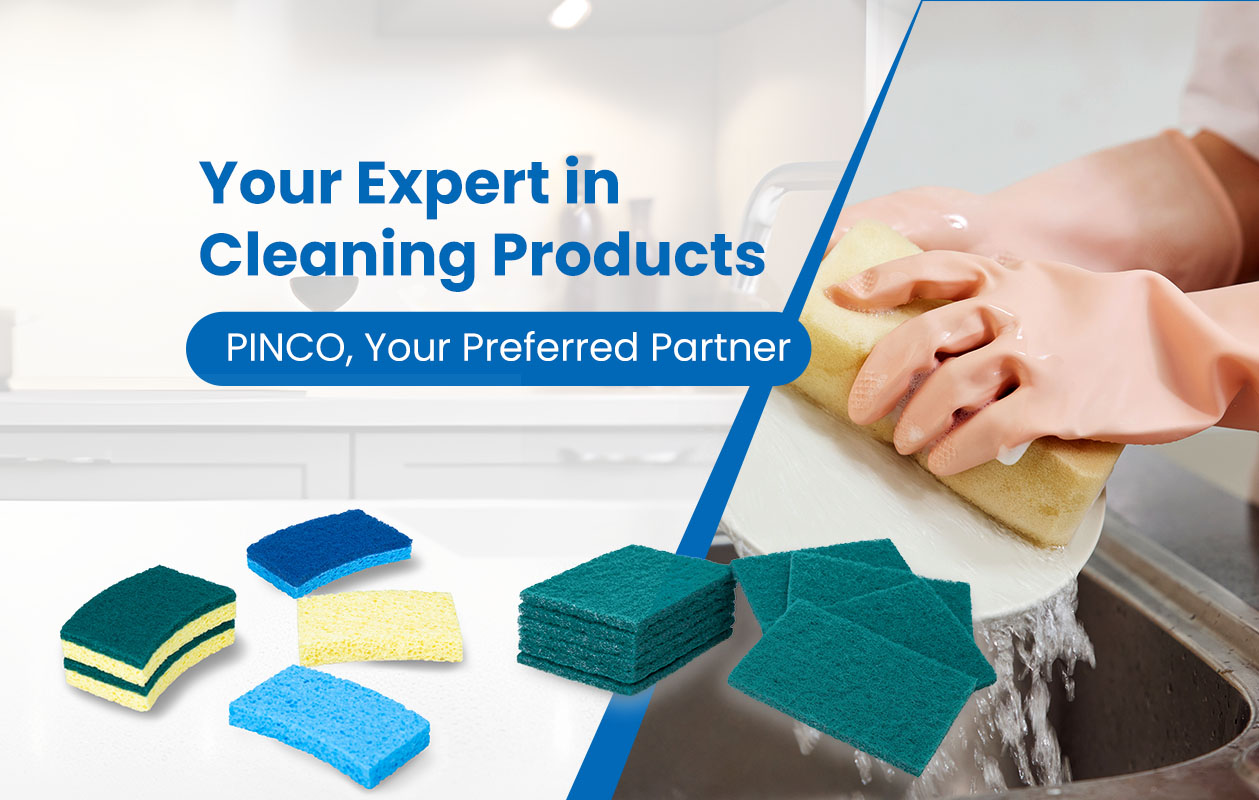
Scouring Pads that combine an abrasive layer with a Sponge or foam layer are widely used in kitchens, hospitality environments, and commercial cleaning operations. While they may appear simple, the durability and cleaning efficiency of these pads depend heavily on how the two layers are bonded.
In bulk and OEM programs, weak bonding leads to delamination, abrasive shedding, and shortened product life. Professional manufacturers with structured production systems apply controlled bonding processes to ensure consistent adhesion strength and wet-use durability. As a dedicated cleaning products manufacturer with specialized scouring pad production lines, PINCO integrates controlled bonding workflows supported by internal QC checkpoints to maintain structural stability in large-scale production.
A typical abrasive sponge pad consists of:
Abrasive fiber layer – contains mineral particles for scrubbing performance
Sponge or foam layer – provides water absorption, cushioning, and ergonomic grip
Bonding interface – adhesive or resin system connecting the two layers
The bonding interface is critical. If improperly applied or cured, the layers may separate during use.
Before adhesive application, both layers must be prepared:
The abrasive fiber web must have uniform density and stable surface texture
The sponge layer must maintain consistent thickness and compression properties
Surface contaminants must be minimized
Controlled surface preparation improves adhesive penetration and bonding strength.
Professional manufacturing typically uses industrial bonding systems designed for durability.
Common controlled methods include:
Roll coating systems to apply adhesive evenly
Spray bonding systems for controlled distribution
Hot melt adhesive application for fast curing and stable adhesion
Resin bonding systems integrated during fiber processing
Uniform adhesive distribution prevents weak bonding zones and excessive glue buildup.
After adhesive application, the abrasive layer and sponge layer are aligned and pressed together.
Critical parameters during lamination include:
Controlled pressure level
Alignment precision
Uniform contact surface
Bonding temperature management
Industrial lamination equipment ensures consistent bonding across the entire sheet before cutting.
Once laminated, the bonded sheet passes through a curing phase.
Depending on adhesive type, curing may involve:
Controlled heating
Timed pressure stabilization
Moisture balance control
Cooling and structural settling
Proper curing ensures that the adhesive fully activates and reaches its designed bonding strength.
Incomplete curing often causes early delamination during wet use.
To ensure durability, professional manufacturers integrate bonding integrity inspection into QC procedures.
Testing methods may include:
Manual peel testing
Wet-condition bonding stress tests
Tear resistance evaluation
Compression recovery testing
Batch-level inspection reduces the risk of layer separation in large shipments.
Manufacturers operating under ISO-aligned quality systems incorporate bonding verification as part of standard inspection.
In hotel kitchens and industrial cleaning environments, scouring pads are exposed to:
Continuous soaking
Repeated squeezing
Cleaning chemicals
High-temperature dishwashing
Bonding systems must withstand these stress factors without adhesive degradation.
Professional manufacturers select adhesive formulations that balance flexibility and strength to prevent brittleness under pressure.
In OEM projects, bonding requirements may vary depending on:
Sponge thickness
Abrasion intensity
Target surface sensitivity
Intended usage environment
Structured OEM workflows include bonding validation during sampling to ensure customized pads maintain structural durability.
PINCO supports OEM/ODM scouring pad programs with controlled bonding processes tailored to different abrasion grades and sponge configurations.
Stable bonding requires:
Dedicated lamination equipment
Trained production operators
Controlled adhesive storage conditions
Defined curing parameters
Consistent production scheduling
Manufacturers with integrated production lines can maintain bonding consistency across high-volume orders.
The bonding of abrasive and sponge layers in scouring pads is a controlled industrial process involving surface preparation, adhesive application, pressure lamination, curing, and rigorous quality inspection.
High-quality pads stand out because:
Adhesive distribution is uniform
Lamination pressure is controlled
Curing is complete
Bond strength is verified before shipment
For bulk commercial and OEM programs, structured bonding processes ensure that scouring pads maintain durability, resist delamination, and perform consistently under wet and high-use conditions.
In large-scale cleaning supply agreements, bonding integrity determines product lifespan and long-term reliability.