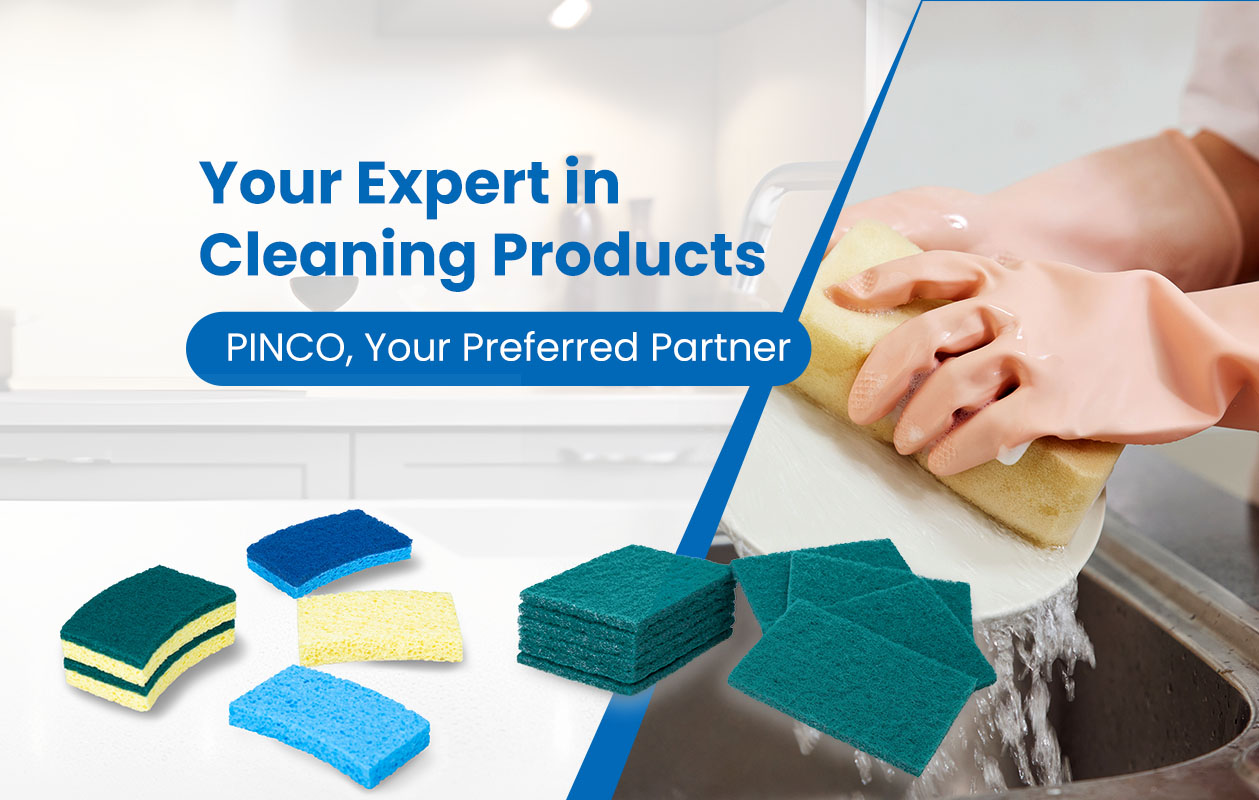
Scouring Pads may appear simple, but their performance consistency depends on a tightly controlled manufacturing workflow. From resin-based fiber structures to abrasive bonding and precision cutting, each production stage influences durability, abrasion strength, and wet-use stability.
For bulk commercial and OEM programs, understanding the full manufacturing process helps buyers evaluate supplier capability and quality control depth. As a professional cleaning products manufacturer with dedicated scouring pad production lines and structured QC systems, PINCO follows an integrated workflow designed for scalable, repeatable output.
Production begins with controlled raw material selection, including:
Synthetic fiber or resin-based web materials
Abrasive minerals suited to defined grade intensity
Adhesive or bonding formulations
At this stage, material consistency is critical. Fiber density and abrasive particle size distribution must align with the targeted abrasion level (non-scratch to extra heavy duty).
Incoming material inspection ensures uniformity before production begins.
The fiber web forms the structural backbone of the scouring pad.
Key control points include:
Fiber dispersion uniformity
Web density consistency
Thickness control
Tensile strength stability
Automated equipment spreads and layers fibers into a stable mat structure. Density variation at this stage directly affects final pad durability.
Once the fiber base is prepared, abrasive minerals are applied.
This stage determines cleaning performance.
Controlled variables include:
Abrasive mineral type
Particle size consistency
Distribution coverage ratio
Surface adhesion uniformity
Professional production lines ensure even abrasive distribution to prevent weak cleaning zones or over-concentration.
The bonding stage secures abrasive particles to the fiber web.
Adhesive systems are applied and cured under controlled conditions.
Critical parameters include:
Adhesive formulation stability
Temperature control during curing
Moisture balance
Bond strength verification
Proper curing ensures that abrasive particles remain attached during wet use and chemical exposure.
After bonding, the material passes through controlled stabilization processes.
This stage ensures:
Consistent thickness
Uniform density
Controlled compression recovery
Structural integrity under pressure
Stable compression behavior is essential for commercial kitchen applications where pads experience repeated squeezing and soaking.
Once the bonded sheet is stabilized, it is cut into specified dimensions.
Precision cutting ensures:
Accurate length and width
Clean edge finishing
Dimensional tolerance compliance
Uniform appearance across batches
Automated cutting equipment reduces deviation in bulk production.
Before packaging, structured inspection checkpoints verify product performance.
Inspection typically includes:
Abrasive strength testing
Thickness measurement
Density verification
Tear resistance testing
Bonding durability evaluation
Visual inspection for uniformity
Batch-level inspection reduces the risk of defect distribution across large shipments.
Manufacturers operating under ISO-aligned systems integrate documented inspection protocols into every production cycle.
Final production stages include:
Bulk or retail packaging
Carton strength verification
Moisture-protection wrapping
Pallet configuration
Clear carton marking
Proper packaging design ensures product stability during sea freight and warehouse storage.
For private-label or customized programs, the workflow includes:
Specification confirmation
Sample validation
Performance benchmarking
Packaging engineering
Controlled mass production release
Structured OEM processes maintain consistency even when customization is introduced.
Industrial scouring pad production requires:
Dedicated production lines
Stable raw material sourcing
Defined daily output capability
Coordinated internal departments
Manufacturers with integrated production systems, such as PINCO, can support large commercial orders with consistent lead times and repeatable quality.
The journey from resin-based fiber material to finished scouring pad involves multiple controlled stages—each influencing durability, abrasion strength, and long-term performance.
High-quality scouring pads are not accidental products. They result from:
Structured raw material selection
Controlled abrasive application
Stable bonding and curing
Precision cutting
Rigorous quality inspection
Export-ready packaging
For bulk commercial and OEM programs, understanding the full manufacturing workflow allows buyers to evaluate supplier capability and ensure scalable, consistent supply.
In large-volume cleaning supply agreements, manufacturing discipline determines product reliability.