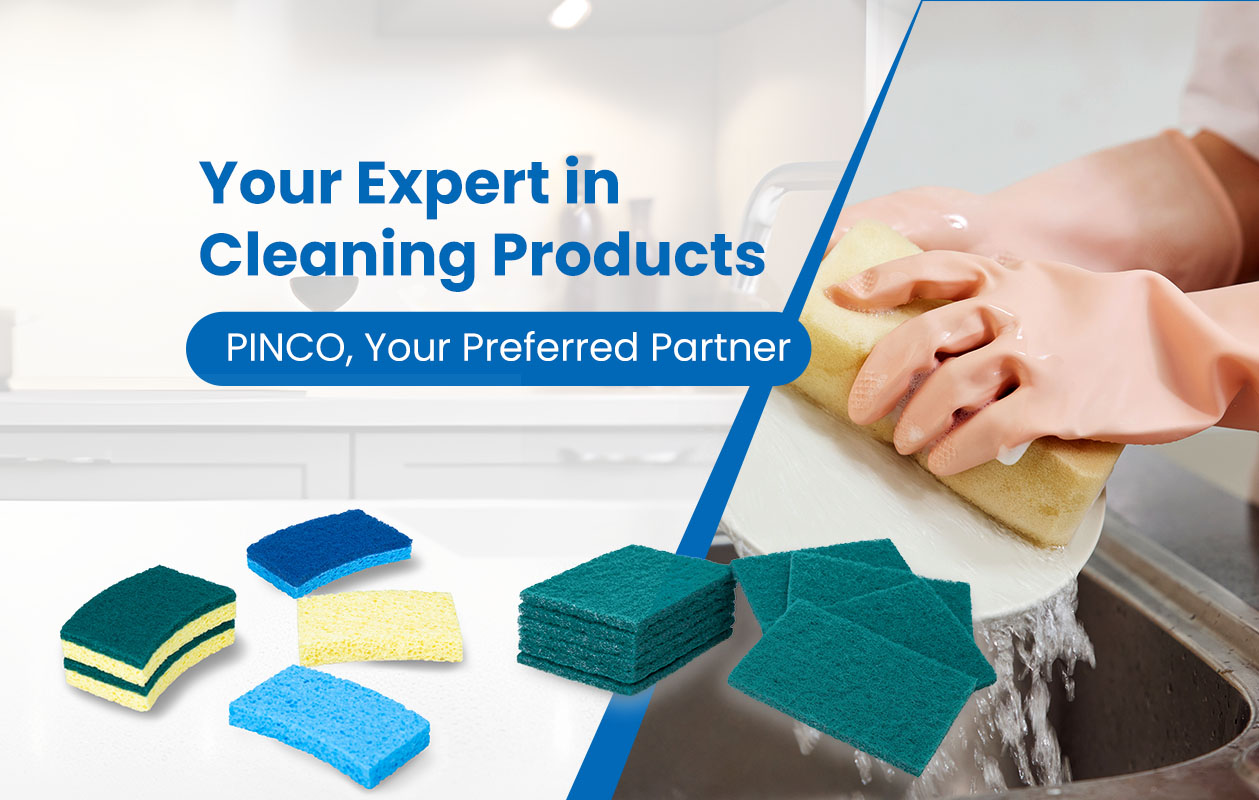
In commercial kitchens, industrial cleaning programs, and private-label retail supply, abrasive cleaning pads must meet clearly defined technical standards. Without a structured specification checklist, buyers risk inconsistent abrasion performance, premature wear, packaging inefficiency, or compliance gaps.
For large-volume procurement, technical specification alignment should be confirmed before sampling and mass production. As a professional cleaning products manufacturer with dedicated Scouring Pad production lines and in-house QC systems, PINCO supports structured OEM/ODM development and bulk export programs based on defined technical parameters.
Clearly define the intended abrasion intensity:
Non-scratch
Light duty
Medium duty
Heavy duty
Extra heavy duty
Each grade must correspond to a measurable difference in abrasive loading, fiber density, and bonding strength. Avoid relying solely on color coding without confirming structural parameters.
Specify exact measurements:
Length
Width
Thickness
Edge finishing type
Include acceptable dimensional tolerance ranges. Commercial projects typically require consistent sizing to avoid packaging mismatch or inconsistent performance.
Confirm structural properties:
Fiber web density
Compression resistance
Recovery after deformation
Tear resistance
Density directly affects durability and abrasive lifespan. In bulk programs, consistent density control prevents early pad breakdown.
Define abrasive system requirements:
Abrasive mineral type
Particle distribution uniformity
Surface coverage ratio
Abrasive retention strength
Abrasive distribution must remain stable across batches to maintain predictable cleaning performance.
The bonding layer influences wet-use durability.
Confirm:
Adhesive formulation stability
Curing method
Water resistance
Delamination resistance
Strong bonding prevents abrasive shedding and layer separation during use.
Clarify intended surfaces:
Stainless steel
Ceramic
Glass
Non-stick cookware
Industrial equipment
Performance expectations vary significantly by surface sensitivity.
For commercial and industrial use, confirm:
Performance in prolonged wet conditions
Resistance to cleaning chemicals
Structural integrity after repeated soaking
Odor control performance
Commercial cleaning programs often expose pads to detergents and sanitizers.
Ensure the manufacturer maintains structured QC processes including:
Abrasive strength testing
Thickness measurement
Density verification
Tear resistance testing
Bonding durability inspection
Batch release documentation
ISO-aligned quality management systems reduce risk in large-scale supply.
Define packaging parameters:
Bulk carton configuration
Units per carton
Carton strength rating
Moisture protection
Pallet stacking requirements
Labeling format
Efficient packaging supports warehouse management and export logistics.
For private-label or project-based programs, confirm:
Custom size capability
Color coding options
Custom branding integration
Retail-ready packaging engineering
Industrial bulk packaging alternatives
Structured OEM processes should include sampling, validation, and pre-production approval.
For commercial-scale orders, verify:
Dedicated production lines
Daily output capacity
Raw material sourcing stability
Lead time consistency
Surge production capability
Scalable production ensures stable bulk supply.
For international procurement, confirm:
Proper carton marking
Country-of-origin labeling
Documentation readiness
Compliance with destination packaging regulations
Batch traceability
Export-ready documentation prevents shipment delays and customs risk.
Before confirming a supplier, verify:
Direct manufacturer capability
Defined technical specification sheet
Sample validation report
QC inspection records
Stable production scheduling
Packaging approval
Export documentation preparation
A structured technical specification checklist ensures abrasive cleaning pads meet performance, durability, and compliance requirements for commercial and export programs.
For large-volume supply, technical clarity reduces production deviation, stabilizes cost, and improves long-term procurement efficiency. Manufacturers with integrated production systems, defined QC checkpoints, and OEM/ODM flexibility—such as PINCO—are better positioned to support repeatable, specification-driven cleaning pad programs.