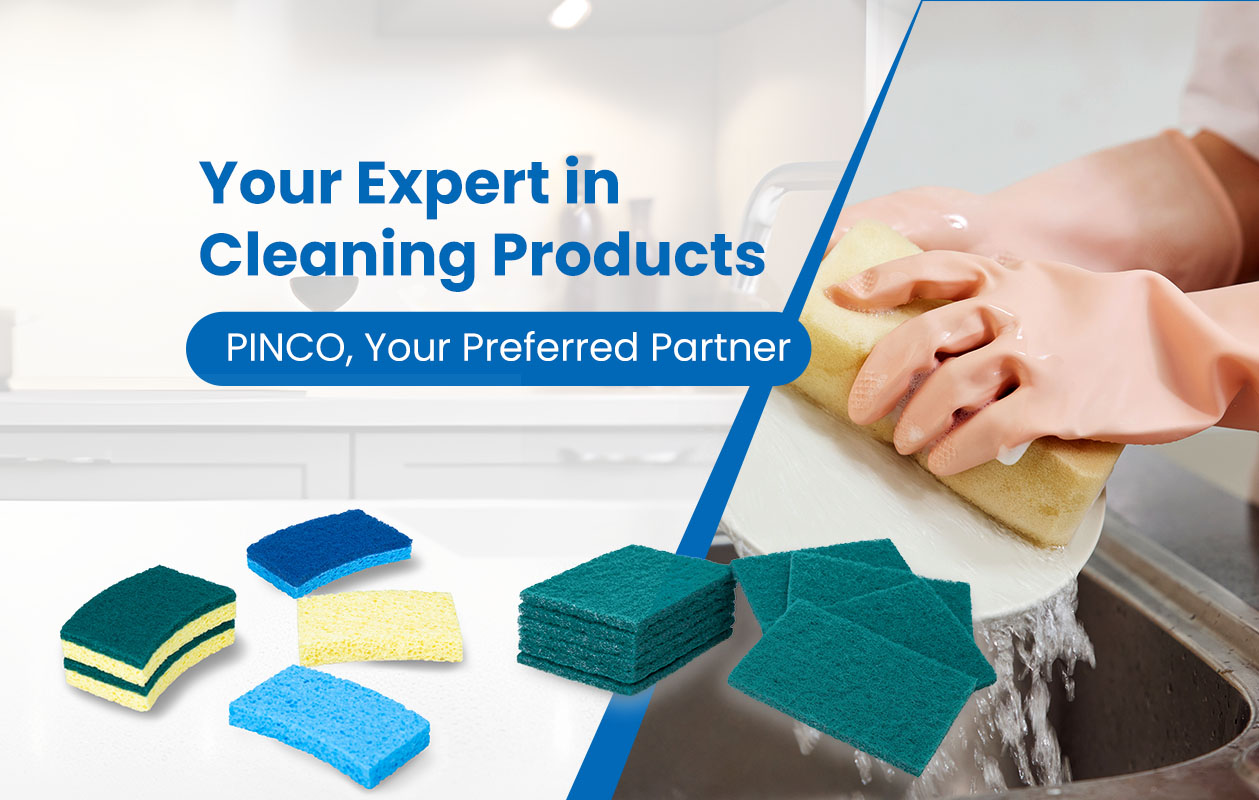
In commercial cleaning projects—such as hotels, hospitals, catering chains, property management groups, and industrial facilities—Scouring Pads are high-consumption items. Because usage volume is large and replacement cycles are short, procurement decisions must balance durability, performance stability, cost control, and supply reliability.
A structured sourcing checklist helps avoid performance inconsistencies, delivery delays, and hidden long-term costs.
As a professional cleaning products manufacturer, PINCO operates dedicated scouring pad production lines supported by in-house QC systems, OEM/ODM capability, and export-ready packaging formats—providing operational stability for commercial bulk programs.
Before comparing prices, confirm supplier type.
Direct Manufacturer Advantages
Control over raw materials and abrasive composition
Dedicated production lines
In-house quality inspection
Stable output capacity
Customization flexibility
Transparent batch traceability
Trader Risks
Limited production visibility
Potential batch inconsistency
Restricted customization options
Less control over lead times
For commercial projects with repeat orders, direct manufacturer sourcing reduces supply chain risk.
Clearly define performance requirements based on application environment:
Abrasion level (non-scratch, light, medium, heavy, extra heavy duty)
Surface compatibility (stainless steel, cookware, tile, industrial equipment)
Thickness tolerance range
Density consistency
Tear resistance under wet conditions
Commercial kitchens and industrial environments often require stronger bonding integrity and more durable abrasive distribution than household-grade pads.
Verify the supplier’s production workflow includes:
Fiber web formation control
Uniform abrasive application
Stable bonding and curing process
Precision cutting and finishing
Structured inspection before packaging
Manufacturers with dedicated production lines provide more stable performance across large orders.
PINCO supports scaled production with defined internal departments and structured manufacturing processes.
Commercial projects demand predictable durability.
Key QC checkpoints should include:
Abrasive strength consistency testing
Thickness and density measurement
Bonding durability checks
Tear resistance testing
Dimensional inspection
Batch release approval
ISO-aligned quality systems reduce risk of high defect rates in large-volume supply.
Commercial cleaning projects often require tailored solutions.
Customization options may include:
Specific pad dimensions
Color coding by department
Density adjustments for durability
Bulk-only packaging formats
Private label branding
Structured OEM workflows ensure that customization does not disrupt production efficiency.
Large commercial contracts require scalable production.
Confirm:
Daily production capacity
Number of dedicated scouring pad lines
Lead time stability
Raw material sourcing reliability
Seasonal surge readiness
Manufacturers with organized production departments can better handle high-volume contracts.
Commercial procurement often involves centralized distribution.
Verify:
Carton strength for stacking
Moisture-resistant packaging
Pallet efficiency optimization
Clear carton labeling
Bulk pack configuration
Optimized packaging reduces storage damage and transportation loss.
Ensure clarity regarding:
Fiber composition
Abrasive mineral type
Bonding formulation
Wet-use durability
Chemical exposure resistance
Material consistency directly affects lifespan and cleaning efficiency.
For international commercial projects, confirm:
Country-of-origin labeling
Proper carton marking
Accurate packing documentation
Compliance with destination market packaging rules
Batch traceability records
Export-ready suppliers reduce customs risk and documentation delays.
Evaluate total cost of ownership rather than only unit price.
Consider:
Volume discount tiers
Forecast-based pricing stability
Reduced defect replacement risk
Logistics optimization
Long-term contract flexibility
Manufacturer-based supply agreements often provide more sustainable cost control than fragmented short-term orders.
Before confirming a supplier for commercial scouring pad programs, verify:
Direct manufacturing capability
Dedicated scouring pad production lines
Internal QC and inspection system
OEM/ODM customization support
Stable bulk output capacity
Export documentation readiness
Structured packaging design
Clear communication channels
Sourcing scouring pads for commercial cleaning projects requires structured evaluation beyond price comparison. Performance durability, quality control discipline, production scalability, and export readiness are critical for large-volume success.
Professional manufacturers with integrated production systems—such as PINCO—provide the operational foundation necessary for stable, repeatable supply across commercial cleaning contracts.
In commercial procurement, structured sourcing reduces risk and supports long-term program efficiency.